
Brand strategy, brand identity and brand guidelines are three separate purchases that arrive in a fixed order. Strategy decides what you stand for and who you are for. Identity turns that decision into a logo, a colour system, a typeface and a way of speaking. Guidelines are the document that lets other people apply the identity correctly when you are not in the room.
Almost every mis-scoped branding project in Malaysia starts with the same conversation. A founder asks for a logo, receives a quote for a three-month strategy engagement and assumes the agency is padding. Or the reverse: a company pays for a positioning workshop, gets a deck full of words, and nobody can point to the thing they can now put on a box. Both sides are talking about different layers of the same job and neither has said which one.
This guide names what sits inside each layer, what each one is not, what changes when you buy them out of order and what to write in the brief before you ask anyone for a price.
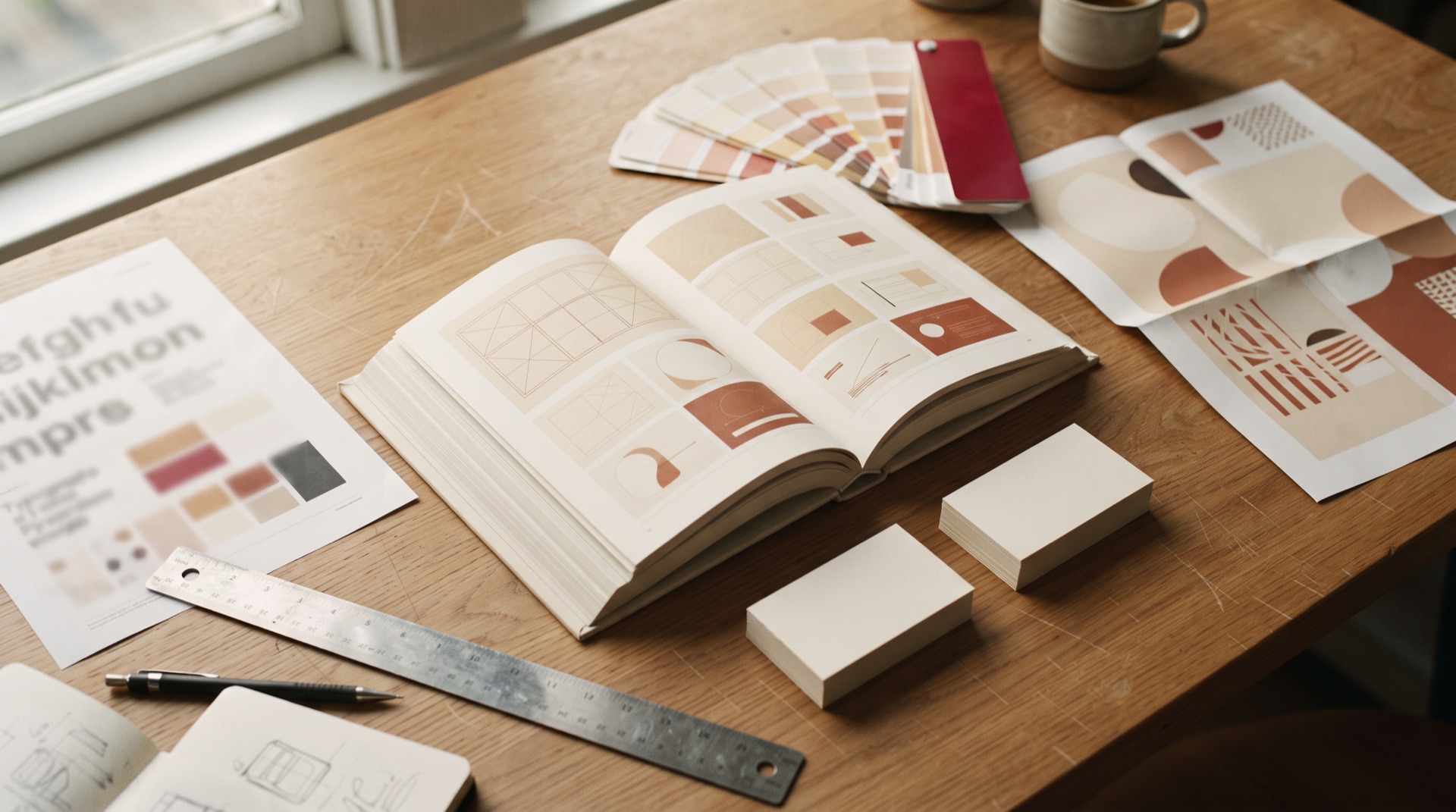
Each layer answers a different question
The clean way to separate them is by the question each one answers, and by who ends up using the output.
Strategy is the only layer that involves a decision about the business rather than a decision about design. It settles who you sell to, what you claim, which competitors you are pricing against and what you refuse to do. If a strategy engagement ends without a sentence you could argue about, you bought a workshop rather than a position.
Identity is the translation. A designer takes the position and produces something a customer can recognise at a distance, on a shelf, in a feed and on a delivery van. The test of an identity is not whether the founder likes it. The test is whether a customer can pick it out without reading the name.
Guidelines are the boring layer and the one that protects the other two. Without them, the identity survives exactly as long as the original designer stays reachable.
The deliverables inside each layer
Ask three agencies for "branding" and you will get three different file lists. Here is the honest breakdown of what each layer delivers and what it does not.
| Layer | What you receive | What it is not |
|---|---|---|
| Brand strategy | A positioning statement, the target segments, the reasons to believe, a message hierarchy and the words you will and will not use | Not a logo, not a campaign and not a marketing plan |
| Brand identity | Logo and lockups in vector and raster, a colour system with print and screen values, a typeface licence or pairing, an imagery direction, an iconography set and a tone of voice with examples | Not a website, not packaging artwork and not a set of ads |
| Brand guidelines | A usage document covering clear space, minimum sizes, correct and incorrect application, colour breakdowns, typography rules, photo direction and file naming, plus editable templates | Not a strategy document, and not a substitute for a designer on complex work |
Two rows in that table cause most of the arguments. Identity is often assumed to include the website, and it does not: the identity is the input to the website build, which is a separate scope with its own timeline. Guidelines are often assumed to be a summary of the identity, and they are more than that. A guideline document is written for a stranger who has never met you and has one afternoon to get it right.
Why the order matters more than the budget
Each layer is the brief for the one after it. Take a layer away and the next one has to guess, which is where the money goes twice.
Buy identity without strategy and the design has no criteria. The review meeting becomes a taste debate because nobody can say what the mark is supposed to do. Three rounds later you pick the one the founder's spouse preferred, and six months after that a competitor launches with a sharper claim and the design suddenly looks generic. The design was never the problem.
Buy guidelines without identity and you are documenting decisions that were never made. The document ends up describing what the last five brochures happened to look like.
Buy strategy and stop there, and nothing changes in market. This is the most common failure among Malaysian companies that have spent real money on brand: the deck is sharp and it sits in a Drive folder while the ads keep running the old message. We wrote about exactly where that handoff breaks in why your brand strategy never made it into your ads.
There is a reason consistency is worth paying for rather than a nice-to-have. Most of the people who will eventually buy from you are not in the market today. The B2B Institute's 95-5 rule puts the share of buyers who are actively buying at any moment at around 5%, which means the other 95% are only building a memory. A brand that looks like four different companies across four channels is asking that memory to do work it cannot do. The IPA's long and short of it research makes the same point from the effectiveness side.
The Malaysian details a global template misses
Most brand guideline templates are written for a single-language market with one script and no certification marks. Malaysia is none of those things.
| Condition | Why it matters | What to specify in the brief |
|---|---|---|
| You sell in two or three languages | Malay, English and often Chinese appear on the same pack, sign or deck, and a logo lockup that works in one script can break in another | Ask for a locked lockup in every language you sell in, with the character set and the fallback font named |
| SSM and MyIPO are separate registers | Registering a company name with SSM does not give you rights over a mark. Trademarks sit under the Trademarks Act 2019 with MyIPO | Run the MyIPO search before the designer starts, not after the artwork is approved |
| A trademark protects a sign, not a mood | MyIPO defines a trademark as a sign capable of being represented graphically, which covers a word, a logo, a shape, a colour, a sound or a combination | Decide which specific elements you intend to register, and make sure the guidelines lock those elements rather than leaving them flexible |
| Certification marks share the space | Halal, HACCP and SIRIM marks have their own clear-space and reproduction rules and they sit on the same pack face as your logo | Give the designer the exact marks on day one, so the pack layout is designed around them |
| Retail and mall signage is specified by the landlord | Illumination, depth, material and sometimes typeface are set per property, and approvals depend on it | Ask for a signage sheet specifying minimum legible size, material and illumination, rather than only a logo file |
| WhatsApp is a primary brand surface | For many Malaysian businesses the first branded thing a customer sees is a business profile and a broadcast message | Include a profile image, a message template and a signature block inside the identity scope |
The SSM point is the expensive one, because a company can trade for years under a name registered on the SSM register, invest in a full identity and then discover the mark is unavailable in the class it needs. The search costs almost nothing and the rework costs everything.
How much of each does your business need
The three layers are not equally weighted at every stage. Spending evenly across them is usually the wrong allocation.
| Stage | Where the money should sit | What you can safely defer |
|---|---|---|
| Pre-launch, or under RM1m revenue | Identity, with a short and decisive positioning exercise in front of it | Full guidelines. A one-page usage sheet holds until you have external vendors |
| RM5m to RM50m, with a team and vendors | Strategy first, then an identity refresh. Guidelines become essential the moment work leaves the building | A full rebrand, if the current mark still has recognition worth keeping |
| Multiple products or sub-brands | Brand architecture, which decides what is endorsed, what is standalone and what gets absorbed | Individual sub-brand identities, until the architecture is settled |
If you do not know which row you are in, that is what an audit is for. Our guide on how to run a brand audit gives you a scored framework you can run yourself in five days, and the score tells you which of the three layers is the weak one. The pricing question for the full rebuild is covered separately in how much a rebrand costs in Malaysia.
Five questions to ask before you sign a branding quote
- Which of the three layers is in this scope, and which are quoted separately? Get it in writing, because "branding" on an invoice means nothing.
- How many logo routes are included, and how many revision rounds after selection? Unlimited rounds is a scheduling risk rather than a benefit.
- Who owns the source files and the typeface licence when we finish? A licence registered to the agency is a problem the first time you print without them.
- Does the guideline document include editable templates, or only rules? Rules alone get ignored by whoever is making the deck at 6pm.
- What happens in month four when we need an asset the guidelines do not cover? Ask for the process, and the rate.
Frequently asked questions
What is the difference between brand strategy and brand identity?
Strategy is a decision about the business: who you serve, what you claim and how you are positioned against alternatives. Identity is the visual and verbal expression of that decision, covering the logo, colour, typography, imagery and tone. Strategy comes first because it is the brief the identity is designed against.
What is included in brand guidelines?
A usable guideline document covers logo variants and clear space, minimum sizes, correct and incorrect usage, the colour system in print and screen values, typography rules with a hierarchy, photography and illustration direction, iconography and application examples on the surfaces you sell through. Editable templates for decks, social posts and documents matter as much as the rules.
Do I need brand strategy if I only want a logo?
You need the decisions, though not always a full engagement. A small business can get to a workable position in a focused half-day session covering who you sell to, what you claim and what you will not do. What you cannot do is skip the decisions and expect a designer to make them for you inside a logo.
Who should write our brand guidelines?
Whoever designed the identity, while the reasoning is still fresh. If the original designer is unavailable, any competent brand studio can document an existing identity, but expect a discovery step first because they will be reverse-engineering rules from finished artwork. Ask to see a full guideline document they have produced before, not a portfolio page.
How much does brand identity cost in Malaysia?
It ranges widely by scope, and the honest answer depends on how many applications are in the deliverable list. We have broken down the real price bands, the statutory fees fixed by law and the third bill that catches most founders in our rebrand cost guide.
How long does the whole process take?
A focused strategy phase runs two to four weeks. Identity design runs four to eight weeks depending on rounds and the number of applications. Guidelines add another two to three weeks, and that phase always takes longer than expected because it is where every unresolved decision surfaces.
Can we update the guidelines ourselves later?
Yes, and you should. Ask for the source file rather than a flat PDF, keep a version number and a date on the cover, and assign one person to own it. A guideline document that nobody owns is out of date within a year.
The bottom line
Strategy decides, identity expresses and guidelines protect. The order is fixed, the layers are priced separately and the most common way to waste a branding budget is to buy the middle layer on its own.
If you want a straight read on which layer your business needs next, talk to us. Brand strategy is one of five disciplines we run under one team, so if the answer turns out to be that your brand is fine and the problem sits in the media or the site, we will tell you that instead.